
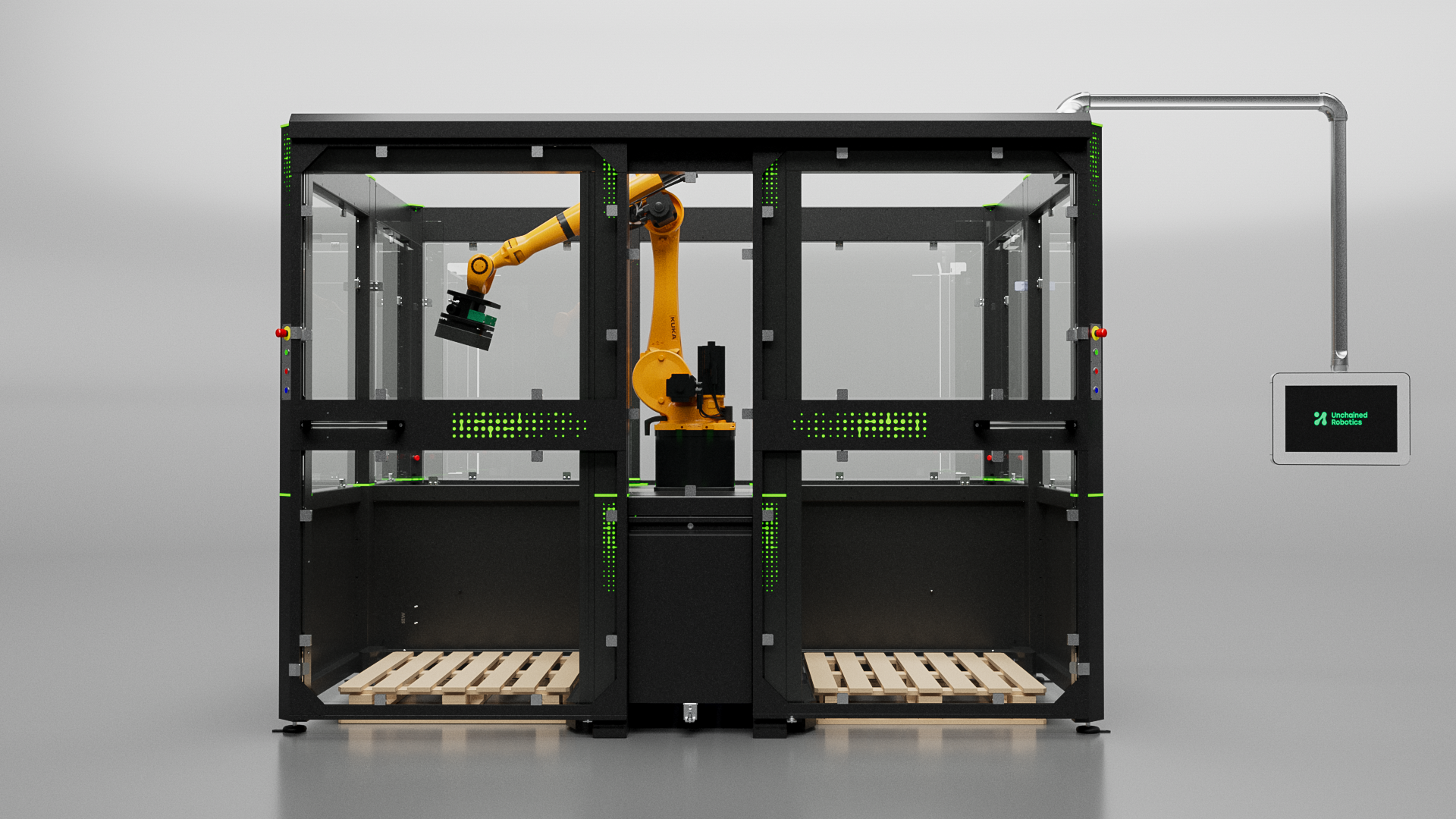
Turnkey Automation
Automation
Commissioning Production Systems in Five Phases

Unchained Robotics
Commissioning a production system brings an assembled system into controlled series production. Before delivery and installation, the factory acceptance test (FAT) takes place at the supplier's premises. On site, commissioning runs in five phases: installation, cold commissioning, hot commissioning with a performance run, acceptance by the operator (SAT), and handover. For a turnkey robot system, the supplier bears primary responsibility. It demonstrates that the system achieves the agreed production volumes, cycle times and quality levels under real conditions. This article explains the process, standards, duration and costs.
Reading time approx. 11 minutes
What does commissioning a production system mean?
Commissioning is the structured transition of a system from its installed state to productive operation. It is not simply a matter of pressing a button. The integrator coordinates all components: robot, gripper, safety equipment, sensors, conveyor systems and control system. It makes adjustments until the process achieves the agreed performance.
Commissioning involves three roles that should remain clearly separate. The manufacturer supplies components with CE marking. The system integrator builds a complete system from them. It prepares the risk assessment for the overall system and applies the CE marking to the cell. The operator prepares the facility. During acceptance testing, it checks whether the agreed performance metrics are achieved.
For a turnkey robot system, the supplier handles both manufacturing and integration. It gets the system up and running. It also provides an acceptance report as evidence that the cycle time, availability and good-part rate meet the agreed values. Commissioning therefore bridges the gap between “technically fully assembled” and “reliably produces good parts in series production”. Set out this division of responsibility in the contract to avoid later disputes about who is responsible for what.
The five phases of commissioning at a glance
Commissioning a production system consists of five phases that build on one another. The sequence is: on-site installation, cold commissioning without a product, hot commissioning with material, acceptance by the operator (SAT), and handover with training. A professional integrator works through these systematically instead of improvising during live production. Before delivery and installation, the factory acceptance test (FAT) takes place at the supplier's premises.
The table shows the typical process: where each phase takes place and what it delivers.
| Phase | Location | Activities | Result |
|---|---|---|---|
| 1. Installation | Your facility | Assembly, alignment, connection of utilities | System is in place and wired |
| 2. Cold commissioning | Your facility | Functional testing without a product, axes, safety, signals | System moves safely |
| 3. Hot commissioning | Your facility | Operation with real material, parameter setting, performance run | Process is stable |
| 4. Acceptance by the operator (SAT) | Your facility | Verification of performance metrics, acceptance report | Responsibility is transferred |
| 5. Handover | Your facility | Training, documentation, release for series production | Start of series production |
For turnkey systems, the first functional test is already carried out at the supplier's premises as a factory acceptance test (FAT). Afterwards, the supplier dismantles and delivers the system. Installation and the two commissioning stages in your facility then repeat the test under real conditions. This phase structure is standard industry practice. It also forms the basis for the terms cold and hot commissioning.
How cold commissioning and hot commissioning differ
Commissioning has two distinct stages. During cold commissioning, the system runs without a product and without process media. Wiring, axis movements, emergency stops, guard doors and signal paths are checked. During hot commissioning, it runs with real material under real process conditions. Only then is the performance run carried out.
Cold commissioning allows faults to be found without risk. As long as no part is in the gripper and no compressed air or adhesive is flowing, troubleshooting remains safe. This makes it possible to correct wiring faults, incorrectly parameterized axes and blocked safety circuits. The integrator executes individual movements in manual mode and checks the end positions. In doing so, it ensures that every safety device stops the system reliably.
Hot commissioning brings the system into real operation. This is where the subtle differences between laboratory conditions and day-to-day production become apparent: dirty parts, slight dimensional deviations and unfamiliar lighting conditions. The integrator sets gripping forces, adjusts camera systems and calibrates positions. It fine-tunes the motion sequences until the process is stable. Experience shows that special cases take the greatest effort, not the standard sequence.
The final step is the performance run. The system operates at its full cycle rate for a defined period. This demonstrates output and availability under series-production loads. This phase is iterative: test, measure, readjust and test again. Be sure to include a time buffer for this. How quickly a cell is ready for production after setup depends heavily on the process. The article Robotics in manufacturing and setup times for industrial robots puts typical setup times into context.
Programming, simulation and offline programming on site
A large part of the programming for a production system takes place before assembly. Offline programming (OLP) means creating the robot program on the digital 3D model of the cell. Three things are therefore checked in advance: motion sequences, reachability and cycle time. Only fine-tuning of the process parameters and adaptation to real tolerances remain for on-site work.
With offline programming, the sequence is created on the 3D model while the real robot continues production. This reduces downtime. Collisions or unreachable positions are identified as early as the planning stage. The simulation also provides a reliable cycle time estimate. This later becomes the basis for the acceptance criteria.
Another element is virtual commissioning. Here, the controller (the real programmable logic controller (PLC) or an emulated controller) runs against a simulated model of the system before any hardware is available. This makes it possible to validate the control logic, including safety checks and interfaces, in advance. This significantly reduces the risk of unpleasant surprises during hot commissioning.
No-code approaches shift more parameter setting to the production floor. With a robot operating system such as LUNA, machine operators configure sequences graphically rather than coding in a manufacturer-specific programming language. This makes subsequent changes to part variants easier. At the same time, it makes the plant operator more independent of the supplier. Make sure you receive the programs, parameter sets and access credentials with the system.
Commissioning success depends not on the robot, but on the interfaces: conveyor systems, the control system and part variants. By separating FAT and SAT properly, you move the expensive surprises from the production floor back to the supplier's factory.
Factory acceptance testing (FAT) and site acceptance testing (SAT)
Acceptance testing takes place in two stages. The factory acceptance test (FAT) checks the fully assembled system at the integrator's premises before it is delivered. The site acceptance test (SAT) is the binding acceptance test in your facility under real conditions. Both are documented in an acceptance report.
The factory acceptance test (FAT) takes place before transport. The operator is usually present. The purpose is to allow faults to be corrected faster and at lower cost at the manufacturer's premises than during live production. The FAT checks three points: whether real parts are handled correctly, the cycle time is achieved and the safety functions work. Send the supplier original parts that are representative, including the difficult variants, in advance.
The site acceptance test (SAT) follows run-in at your facility. Over a defined period or for a defined number of parts, the system demonstrates the performance metrics agreed in the contract. Once the SAT has been passed, responsibility formally transfers to the operator. A payment installment is usually then due.
| Criterion | FAT (factory acceptance test) | SAT (on-site acceptance test) |
|---|---|---|
| Location | At the integrator's premises | In your facility |
| Timing | Before delivery | After run-in |
| Parts | Original parts delivered in advance | Actual series-production parts in operation |
| Test scope | Basic functions, cycle time, safety | Output, availability, good-part rate |
| Legal consequence | Release for shipment | Transfer of risk, payment installment |
The SAT usually checks four metrics:
- Cycle time and output: number of parts per hour or shift.
- Availability: operation without unplanned downtime.
- Quality: good-part rate and scrap.
- Safety: safety devices and documented CE compliance.
Define these acceptance criteria, including the measurement period, in the contract rather than waiting until the SAT. Clear, measurable metrics protect both parties.
Safety and standards during commissioning
A production system may only be commissioned after a risk assessment and documented safety inspection. The legal framework comprises the Machinery Directive 2006/42/EC, the harmonized standards EN ISO 10218-1 and -2 for industrial robots, and the German Ordinance on Industrial Safety and Health for the operator. At the end, the overall system receives its CE marking.
The Machinery Directive 2006/42/EC requires the manufacturer of the overall system to carry out a risk assessment, compile technical documentation and issue a declaration of conformity. Two standards specify the requirements for robot systems in more detail: EN ISO 10218-1 (robot) and EN ISO 10218-2 (robot system and integration). For collaborative applications, the ISO/TS 15066 specification for cobot operation also applies. It specifies permissible forces and pressures during human-robot contact.
Commissioning maintains a clear separation between manufacturer and operator obligations. The manufacturer (the integrator for turnkey cells) carries out the risk assessment in accordance with EN ISO 12100 and applies the CE marking. Before the system is used for the first time, the operator prepares a workplace risk assessment in accordance with the German Ordinance on Industrial Safety and Health. It also sets out inspection and training requirements. Information 209-074 from the German Social Accident Insurance (DGUV) on industrial robots provides practical guidance.
From January 20, 2027, the EU Machinery Regulation (EU) 2023/1230 will replace the existing Machinery Directive. Systems placed on the market for the first time after that date must meet the new requirements. The article on the EU Machinery Regulation for robot cells explains what this means in practice for operators. Among other things, this affects cybersecurity and safety-related software. If your planned system is due to be commissioned during this period, clarify the transition with the integrator early on.
Turnkey robot cell versus in-house integration
A turnkey robot system is a preconfigured automation system. The robot, gripper, controller and safety equipment are supplied as a complete, coordinated and acceptance-tested package. The operator receives a fully tested cell with CE marking, rather than integrating individual components and taking responsibility for them itself.
With in-house integration, the operator purchases the robot, end effector and peripherals separately. This means it takes on the role of manufacturer of the overall system itself. It must carry out its own risk assessment, apply its own CE marking, do its own programming and take full responsibility for how everything works together. This can be cheaper. However, it requires in-house automation expertise, which is often lacking, especially when skilled workers are in short supply.
The turnkey cell shifts this burden to the supplier. The integrator delivers an acceptance-tested system. It demonstrates the performance metrics through FAT and SAT and hands over the documentation, including the declaration of conformity. This shortens ramp-up and clearly assigns responsibility. However, it costs more to purchase than buying components alone.
| Aspect | Turnkey robot cell | In-house integration |
|---|---|---|
| Responsibility for overall system | Supplier | Operator |
| CE marking | Supplier | Operator |
| Required expertise | Low | High |
| Ramp-up time | Short, as delivered after acceptance testing | Longer, as integration is carried out in-house |
| Purchase costs | Higher | Lower if in-house expertise is available |
A turnkey automation cell such as the MalocherBot combines the robot, gripper and controller into an acceptance-tested unit. If you are looking for individual components, you will find them on the Unchained Robotics marketplace for robots, cobots and grippers. Choosing the right gripper has a major impact on the effort required during run-in. The guide to types of end effectors for industrial robots can help with this.
Integration into existing production lines is the biggest hurdle
Integration into existing production lines is the most demanding part of commissioning. Delays arise at the interfaces, not at the robot itself. Four points are critical:
- Connection to the higher-level PLC.
- Data exchange with MES (Manufacturing Execution System) or ERP (Enterprise Resource Planning).
- Transfer points to existing conveyor systems.
- Coordination of cycle times with neighboring stations.
Commissioning in an existing line requires thorough preparation of the facility. These requirements should be clarified in writing before delivery:
- Installation area and foundation: sufficient space, a level floor with sufficient load-bearing capacity, and anchoring if necessary.
- Utility connections: power supply at the correct voltage and with the correct circuit protection, compressed air, and network and data connections to MES or ERP if required.
- Access and logistics: crane or forklift for unloading, clear routes to the installation location.
- Environment: climate, cleanliness and lighting appropriate for the system, especially with camera-based machine vision.
At the control level, the PLC connection determines how mature the integration is. Signals for start, stop, faults and material requests must be synchronized with the line so that the cell keeps pace. Camera-based processes also involve machine vision. Its reliability depends heavily on consistent lighting conditions. This is exactly where most of the time in hot commissioning is spent on calibration and special cases.
A practical example from warehouse automation shows how integration into established structures can be achieved: How Arvato is expanding its warehouse automation with Unchained Robotics. An internal contact person knows the process and is authorized to make decisions. This makes every query faster to resolve during run-in.
Estimating commissioning time and costs realistically
On-site commissioning of a production system takes from a few days to several months. It costs roughly 10% to 20% of the investment in the system. There are three levels of complexity: a simple pick-and-place cell, medium-complexity palletizing with variants, and a complex system with machine vision. A simple cell with a single part often starts up in a few days. A complex system with many part variants and an MES connection takes several weeks to months. FAT, transport and training come on top of this.
| Complexity | Example | On-site duration (guideline) |
|---|---|---|
| Simple | Standardized pick-and-place, one part | A few days to 1 week |
| Medium | Palletizing with several variants | 1 to 3 weeks |
| Complex | Machine vision, many part variants, MES connection | Several weeks to months |
Stability at the end is more important than duration alone. A slightly longer commissioning period results in a reliably running process. This is cheaper than a rushed ramp-up with persistent faults. Idle days caused by missing connections or an installation location that has not been cleared are the most common avoidable source of costs.
Costs are divided into the system price and the commissioning work. The commissioning portion covers assembly, run-in, FAT and SAT, and training. It usually accounts for 10% to 20% of the investment in the system, depending on complexity and travel distances. Depending on its scope, a turnkey robot cell falls within a wide price range. The cost drivers are the gripper, machine vision and the number of part variants. The article What does a turnkey robotic solution cost? puts this into context.
Frequently asked questions
How long does it take to commission a production system?
Depending on complexity, on-site commissioning takes from a few days to several months. A simple pick-and-place cell starts up within a few days. A complex system with machine vision and an MES connection takes several weeks to months. Factory acceptance testing, transport and training must also be included in the schedule.
What is the difference between cold commissioning and hot commissioning?
During cold commissioning, the system runs without a product and without process media. Wiring, axis movements and safety functions are checked. During hot commissioning, it runs with real material under real conditions. At this point, the integrator sets the process parameters and carries out the performance run.
What do FAT and SAT mean for system acceptance?
The factory acceptance test (FAT) is carried out at the integrator's premises before delivery. The site acceptance test (SAT) is the binding acceptance test at your facility under series-production conditions. Once the SAT has been passed, responsibility transfers to the operator. Both are documented in the acceptance report.
Which standards apply when commissioning a robot system?
The relevant requirements are the Machinery Directive 2006/42/EC, standards EN ISO 10218-1 and -2 for industrial robots, and the German Ordinance on Industrial Safety and Health for the operator. ISO/TS 15066 also applies to cobots. The EU Machinery Regulation (EU) 2023/1230 applies from January 20, 2027.
Who is responsible for commissioning, the manufacturer or the operator?
For a turnkey robot system, the supplier bears primary responsibility: it integrates the system, carries out the risk assessment, applies the CE marking and demonstrates the performance metrics. The operator prepares the facility and checks during acceptance testing that the agreed values are achieved.
How is a robot integrated into an existing system?
Integration takes place via interfaces to the higher-level PLC, data exchange with MES or ERP, and coordination of cycle times with neighboring stations. Prerequisites are a prepared installation area, utility connections and access. Most of the effort goes into signal coordination, machine vision and special cases, not the robot itself.
What is a turnkey robot system?
A turnkey robot system is a preconfigured automation system. The supplier provides the robot, gripper, controller and safety equipment as an acceptance-tested complete package. The operator receives a fully tested cell with CE marking. After commissioning, it can use the cell directly for production without having to carry out the integration itself.