
Image Processing
Robot
Automation
Bin-Picking Robots: 3D Vision, Grippers, and the Choice Between CAD Matching and AI

Unchained Robotics
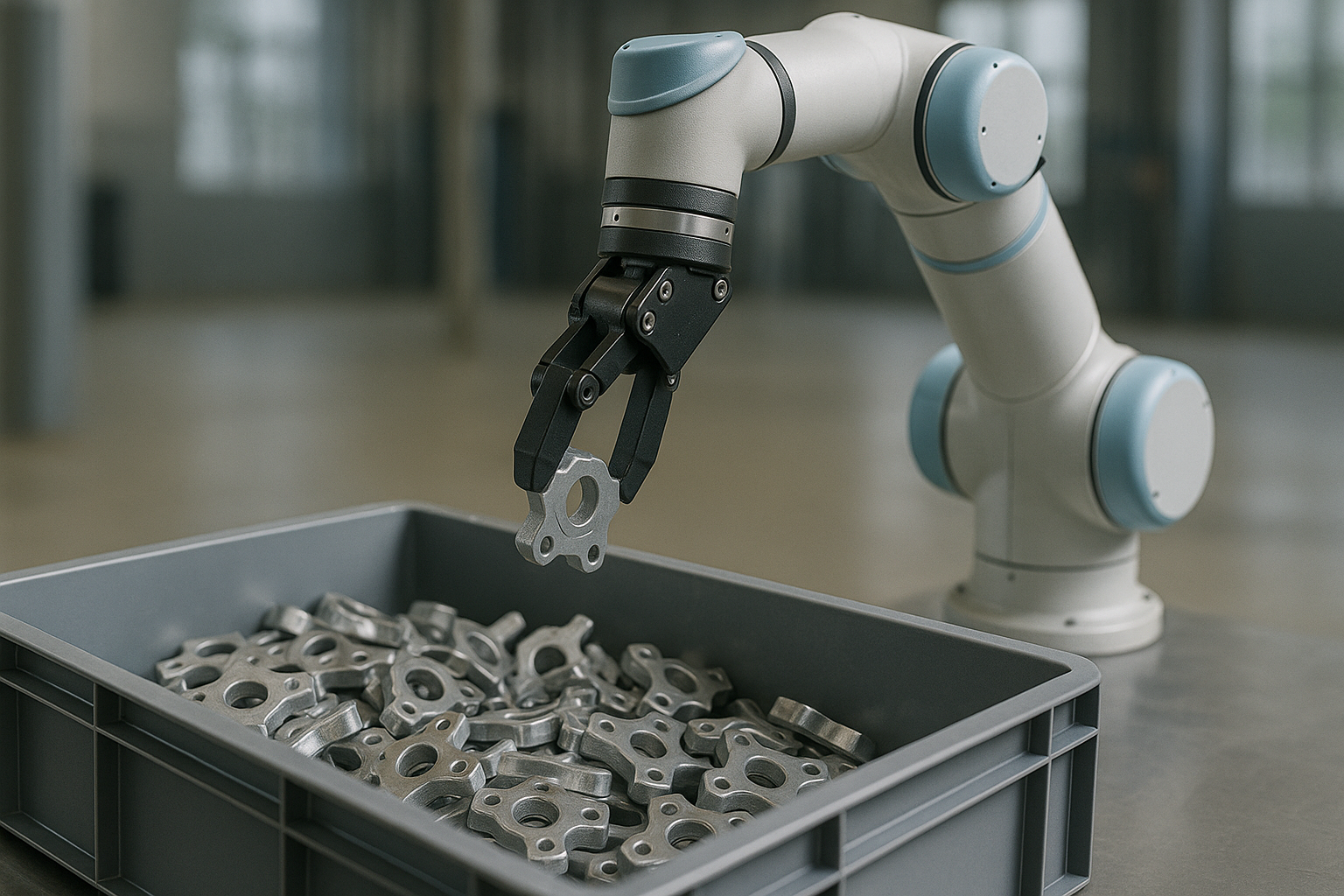
Bin picking refers to the automated retrieval of items from a bin. A robot detects parts stacked haphazardly in a container, determines the position and orientation of each object, and retrieves them one by one. The bottleneck is rarely the robot arm itself, but rather the machine vision system. It calculates a safe gripping point from a pile of randomly oriented parts. This article highlights three key points. First, how the 3D vision pipeline works. Second, how 2D, 3D, and AI systems differ. Third, how to choose between CAD matching and AI object recognition.
What Is Bin Picking and How Does a Robot Reach Into a Bin?
Bin picking is the automated identification and retrieval of individual objects from a disordered container by a robot. A camera system captures the contents of the container. Software determines the position and orientation of each part. The robot picks out one object after another.
Bin picking always follows the same basic sequence: capture, recognize, grasp, and place. The difference from traditional handling lies in the disorder. Parts do not arrive individually and aligned on a conveyor belt, but are stacked randomly on top of one another in a mesh box or crate. Technically, three levels are distinguished. In structured picking, the parts are arranged in ordered layers. In semi-structured picking, they lie on a single plane but without a fixed position. In true random bin picking, they are stacked chaotically. This is precisely where the robot needs 3D image data instead of a simple 2D image.
The objects are usually identical. In the majority of real-world applications, a single, uniform part type is contained in the bin. These include cast blanks, screws, injection-molded parts, or packaged goods. This simplifies recognition because the system searches for a known object rather than arbitrary shapes.
Why Bin Picking Remains Technically Challenging for Robots
Bin picking is challenging because the robot must determine the position of each part in six degrees of freedom. The objects obscure one another, cast shadows, and change their orientation with every grasp. Deriving a collision-free grasping motion from a static image is the real problem.
Bin picking usually fails due to five recurring obstacles:
- Random Orientation: Parts are oriented in random directions. If the robot grasps incorrectly, it displaces neighboring parts or grabs two at once.
- Occlusion and stacking: Tightly stacked objects obscure one another; parts located lower down are barely accessible.
- Varying shape and material: If the shape, size, or surface changes, detection becomes more difficult. Shiny, dark, or transparent parts confuse the sensors.
- Lighting conditions: Changing or dim ambient light interferes with the camera and leads to misgrabs.
- Separation: Workpieces with complex geometries can become entangled or stuck together, making it difficult to remove them individually.
The Tool Center Point (TCP)—that is, the gripper’s defined working point—must be able to move into the box without colliding with anything. Shiny metal surfaces and the edge of the bin are common causes of failed grasping attempts. This is precisely why the quality of image processing determines the success of the project. The robot’s payload capacity and reach are secondary considerations.
A Comparison of 2D, 3D, and AI Image Processing for Bin Picking
Bin picking utilizes three classes of image processing. 2D cameras provide only a two-dimensional image. 3D sensors generate a point cloud with depth information. AI-supported systems can recognize objects even without an exact model. For true unordered grasping, 3D information is essential. AI extends this capability to difficult objects.
A 2D camera is sufficient only if parts are flat and separated on a single plane, because it lacks height information. As soon as parts are stacked on top of one another, the system requires 3D. Four sensor principles have become established for this purpose:
| Sensor Principle | How It Works | Strength | Weakness |
|---|---|---|---|
| Structured Light | Projects patterns and measures their distortion | High accuracy at close range | Sensitive to extraneous light |
| Stereo Vision | Two cameras calculate depth from parallax | Robust, passive, cost-effective | Less effective on surfaces with little texture |
| Time of Flight (ToF) | Measures the time it takes for reflected light to return | Fast, large working range | Lower detail resolution |
| Laser triangulation | Laser line plus angle measurement | Very precise, works well with metal | Slower, often involves moving the scanner |
The point cloud is the intermediate output of every 3D system. It consists of millions of 3D points and describes the surface of the container’s contents. The software uses it to calculate the pose of each part. AI object recognition adds another layer on top of this. Instead of comparing a part purely geometrically, it uses trained models. This allows it to detect even dark, transparent, or changing objects that traditional methods fail to identify. You can find suitable 3D cameras and vision systems bundled together in the Unchained Robotics Marketplace.
The Bin-Picking Pipeline from Point Cloud to Grasping Point
Bin picking proceeds in three sequential stages: Perception (acquisition and recognition), Grasp Prediction (grasp point determination), and Robot Control (path planning and execution). Each stage must be completed within the cycle time; otherwise, image processing slows down the entire cycle.
Bin picking begins with perception. The 3D sensor generates a point cloud of the bin. The software filters out noise points and the bin’s edge and then performs pose estimation. Pose estimation refers to determining the position and orientation of each detected part in six degrees of freedom. This is where CAD matching (comparison against a stored 3D model) differs from AI object recognition (trained model instead of exact geometry).
In Grasp Prediction, the system calculates a specific, reachable grasping point based on the detected pose. It evaluates which part is sufficiently exposed, where the gripper can make a secure contact, and whether the gripping force is sufficient. If there are multiple candidates, it selects the grasp with the highest probability of success.
Robot Control executes the grasp. Path planning generates a collision-free trajectory into and out of the bin. Collision avoidance checks the bin walls, neighboring parts, and the robot itself. Only then does the TCP move to the grasping point, remove the part, and place it in the correct orientation. For the next pick, the cycle starts over, often with a fresh selection. The pile eventually shifts with each pick.
Cambrian Vision as an AI-Based Bin Picking Solution
Cambrian Vision is an AI-powered image processing solution for challenging objects. These include dark, shiny, semi-transparent, or unusually shaped parts that push traditional 3D systems to their limits. The solution operates reliably even in low or fluctuating light conditions.
Cambrian Vision utilizes imaging and machine learning. This allows it to reliably detect and grasp objects even in visually challenging environments. That is precisely where its advantage lies. Black, dark, or semi-transparent workpieces push many 3D systems to their limits. This system processes them consistently. In practice, it uses two cameras. These are typically mounted on the robot arm and capture the container as it moves.
The system requires a CAD file of the workpiece, which is used to determine the optimal gripping position. This data is then used to calculate an AI model capable of reliably locating and gripping the part. This is crucial for system design. It determines how much preparation a new part requires. And it determines how well the system handles variations in shape and size.
Mech-Mind Mech-Eye: A 3D Camera System for Variable Objects
Mech-Mind Mech-Eye is a series of 3D vision systems. It is available in several variants with different working distances and fields of view. The cameras can detect even small, complex, or highly detailed parts and are software-compatible with common robot brands.
Mech-Mind Mech-Eye combines two built-in cameras and integrated processing into a single unit. The software analyzes the contents of the container and determines the position and orientation of the parts. It then transmits the gripper points and a suggested path to the robot. The key feature is this broad software compatibility. Because the control system works with the systems of many robot manufacturers, the integration effort is significantly reduced.
Mech-Mind Mech-Eye really shines in applications where parts change relatively frequently. The variants cover a range of working distances. This allows the system to be configured for small precision parts as well as for large components in deep mesh bins. This makes it suitable for workstations with a varying range of parts. A system rigidly configured for a single object would be too inflexible in such cases.
Cambrian Vision and Mech-Mind Mech-Eye in a Direct Comparison
Bin-picking robots equipped with Cambrian Vision and Mech-Mind Mech-Eye tackle the same problem from two different angles. Cambrian relies on AI recognition for visually challenging objects. Mech-Mind relies on a flexible 3D camera system with broad robot compatibility for changing parts. The choice depends on the range of parts and their surface characteristics.
| Criterion | Cambrian Vision | Mech-Mind Mech-Eye |
|---|---|---|
| Approach | AI-powered image processing | 3D Vision Camera Series |
| Strength | Dark, shiny, transparent, and unusual parts | Varying part types, wide range of sizes |
| Camera Setup | Two cameras, mounted on the robot arm | Two cameras, integrated processing |
| Light robustness | Even in low, fluctuating light | Depends on the model |
| Robot compatibility | Software-compatible with most major robot brands | Software-compatible with most major robot brands |
| Ideal for | Visually demanding surfaces | Frequently changing objects |
Cambrian Vision is the top choice when the surface is the main challenge. This applies to shiny metallic, black, or transparent workpieces in low-light conditions. Mech-Mind Mech-Eye is the top choice when flexibility and easy integration into an existing robot fleet are key. Both are solid starting points. The final decision should be based on the actual part, ideally through a feasibility test using your own workpieces.
Which gripper is right for your bin picking application
The gripper plays a key role in determining the pick rate during bin picking. In a tight, full bin, it must be able to approach the part without colliding. Three end-effector types dominate: vacuum grippers, two-finger parallel grippers, and magnetic grippers. The choice depends on the material, geometry, and accessibility of the part.
An end-effector is the tool attached to the robot flange—in this case, the gripper. When reaching into the bin, a slim design is particularly important. The gripper must be able to reach between closely packed parts and up to the edge of the bin without displacing neighboring parts.
| Grippers | Principle | Suitable for | Limit |
|---|---|---|---|
| Vacuum Gripper | Suction cups, negative pressure | Flat, dense, smooth surfaces (cardboard boxes, sheet metal, bags) | Porous, highly curved, or perforated parts |
| Two-finger parallel gripper | Form-fit, two jaws | Defined geometries, cylinders, cubes, castings | Very large or interlocked parts in a tight box |
| Magnetic gripper | Magnetic force | Ferromagnetic metal parts | Magnetic materials only; multiple parts can be held |
Vacuum grippers are the standard in logistics because they are fast and lightweight. Two-finger grippers dominate in manufacturing when handling defined components. Magnetic grippers are unbeatable for steel parts, but occasionally pick up multiple parts unintentionally. For challenging applications, some cells combine multiple gripping principles in a switchable system. You can find suitable end-effectors on the Unchained Robotics Marketplace. The guide to gripper and end-effector selection covers the details.
Bin Picking in Manufacturing, Logistics, Agriculture, and Medical Technology
Bin picking is widely used in four industries: manufacturing, logistics, agriculture, and medical technology. In manufacturing, it feeds raw parts to production lines. In logistics, it picks and packs goods for shipment. Agriculture and medical technology use it for sorting and de-bunching.
In manufacturing, bin picking is typically used to feed machines and assembly lines. It delivers cast blanks, screws, or injection-molded parts directly from the delivery bin. This increases plant utilization and reduces the workload on machine operators.
In logistics, bin picking retrieves packages, bags, and individual items from collection bins. It places them in sorted piles for shipping or further processing. This increases the speed and accuracy of the picking process while reducing manual handling.
In agriculture, bin picking sorts and organizes produce and other goods by size or degree of ripeness. In medical technology and healthcare, it retrieves and transports consumables, tablets, or small parts in compliance with hygiene requirements. The common thread is always the same: wherever parts arrive in a disorganized state and are processed individually, bin picking replaces monotonous, physically demanding manual labor.
Costs, Cycle Time, and ROI of a Bin-Picking Robot
A bin-picking system consists of a robot, 3D vision, a gripper, software, and integration. This drives the investment cost beyond the price of the robot alone. Cycle time and pick rate—that is, how many successful picks per hour the system can reliably achieve—are crucial for cost-effectiveness.
Bin picking pays off when a system replaces one or more shifts of monotonous picking work. To do so, it must maintain a high pick rate. The pick rate is the percentage of successful picks out of all attempts. It drops when parts get snagged, detection becomes unreliable, or the gripper cannot make contact with the part inside the box. The cycle time includes pickup, detection, gripping motion, and placement. In practice, typical cycle times range from a few seconds per pick, depending on the part and the camera.
The key performance metrics for a specific application depend heavily on the part and the cell.
Those who don’t want to handle the integration themselves can opt for a turnkey cell. The MalocherBot from Unchained Robotics combines a robot, vision system, and gripper into a preconfigured automation cell. The no-code robot OS LUNA controls the process without traditional robot programming.
Why Bin Picking Projects Fail—and How to Avoid It
Bin picking projects rarely fail because of the robot; they almost always fail due to image processing, the gripper, or the part itself. The three most common causes are reflective surfaces, an unsuitable gripper, and a part range that is broader than anticipated.
Bin picking works reliably if you clarify four points in advance:
- Accurately classify the part: Shiny, dark, or transparent surfaces require AI-powered recognition, such as that offered by Cambrian Vision, not just a standard 3D camera.
- Check gripability: A vacuum, two-finger, or magnetic gripper must match the part’s geometry. In a full bin, it must be able to reach the part at all.
- Control the lighting: Fluctuating ambient light interferes with recognition. Defined lighting or a light-robust system ensures a high pick rate.
- Test feasibility: A test with your actual workpieces reveals snags, double grips, and detection gaps before the cell is ordered.
A cobot (a collaborative robot that is permitted to work alongside humans without a protective barrier) can handle bin picking. The prerequisites are that the payload, reach, and cycle time are suitable. For heavy parts or high cycle rates, a traditional industrial robot is the better choice. You’ll find a selection of cobots in the Marketplace. The most important factor remains a realistic assessment of your own part. This determines the optimal combination of vision, gripper, and robot.
Frequently Asked Questions About Bin-Picking Robots
What is bin picking, explained simply?
Bin picking is the automated process of retrieving parts from a bin. A robot uses a 3D camera to detect parts lying in a random arrangement inside a container. It determines the position and orientation of each part and retrieves them individually. In German, the term is “Griff in die Kiste” or “Behälterkommissionierung.”
How much does a bin-picking robot cost?
The investment includes the robot, 3D vision system, gripper, software, and integration, and is significantly higher than the price of the robot alone. [AUTHOR INPUT REQUIRED: Specific price range for a turnkey bin-picking cell from Unchained Robotics, such as the entry-level price for the MalocherBot.] The return on investment depends on the pick rate, cycle time, and the number of work hours replaced.
What kind of camera does a robot need for bin picking?
For unordered grasping, a robot needs a 3D camera system that generates a point cloud of the bin’s contents. Structured light, stereo vision, time-of-flight, or laser triangulation serve as the basis. For dark, shiny, or transparent parts, AI-based object recognition supplements the pure 3D measurement.
What is the difference between CAD matching and AI-based object recognition?
CAD matching compares the point cloud against a stored 3D model of the part and is suitable for known, consistent workpieces. AI-based object recognition uses trained models. It also recognizes varying, optically challenging, or deformable parts for which no exact model is available. CAD matching is more precise for known parts, while AI is more flexible for a varying range of parts.
Which gripper is suitable for bin picking?
Vacuum grippers are suitable for flat, smooth surfaces such as cardboard boxes or sheet metal. Two-finger parallel grippers are suitable for defined geometries such as castings or cylinders. Magnetic grippers are suitable for ferromagnetic metal parts. In addition to the material, the design is crucial. The gripper must be slim enough to reach the part inside a full box.
Can a cobot handle bin picking?
A cobot can perform bin picking as long as the payload, reach, and required cycle time remain within acceptable limits. Its advantage is that it can operate without a separating safety fence. For heavy parts or very high cycle rates, a traditional industrial robot with greater speed and payload capacity is the more suitable choice.
How fast is a bin-picking robot?
Speed is measured in cycle time per pick and in pick rate—that is, the percentage of successful picks. Depending on the part, camera, and gripper, typical cycle times range from a few seconds per pick.
In which industries is bin picking worthwhile?
Bin picking is beneficial in four areas. In manufacturing, it feeds machines and assembly lines. In logistics, it picks and packs goods. In agriculture, it sorts produce. In medical technology, it separates consumables. The common thread is parts arriving in a random order that are then processed individually.