
Turnkey Automation
Automation

Robot grippers cost around 200 to 6,000 euros for the hardware alone, depending on the gripping technology. Custom solutions and complete vacuum systems cost more. The gripper body, however, is rarely the largest expense. Sensors, adapted gripping jaws, integration and ongoing maintenance also affect the total. They determine whether a gripper is affordable or expensive when all costs are considered. This article breaks down prices by gripper type, names example models and shows the costs beyond the purchase price.
Reading time approx. 12 minutes
Robot grippers typically cost 200 to 6,000 euros for standard hardware. Basic pneumatic models start at around 200 euros, while electric servo grippers with sensors cost 6,000 euros or more. Custom end effectors or complete vacuum systems exceed this range at the upper end.
The end effector, also known as end-of-arm tooling (EOAT), is the generic term for tools mounted on the robot flange, such as screwdriving or welding tools. Robot grippers are also end effectors. They are the tool at the tool center point (TCP), the point of action at the end of the robot arm. The robot handles movement and positioning, while the gripper makes direct contact with the workpiece. This is exactly why prices vary so widely. A gripper for uniform sheet metal parts has different requirements from one for sensitive electronic assemblies.
The broad market range for new industrial gripping solutions is around 500 to 8,000 euros. This applies to grippers and vacuum systems combined. This range provides rough guidance for hardware costs. Design, integration and commissioning are added separately. Our guide to the types of end effectors for industrial robots covers the options and explains how to select the right one.
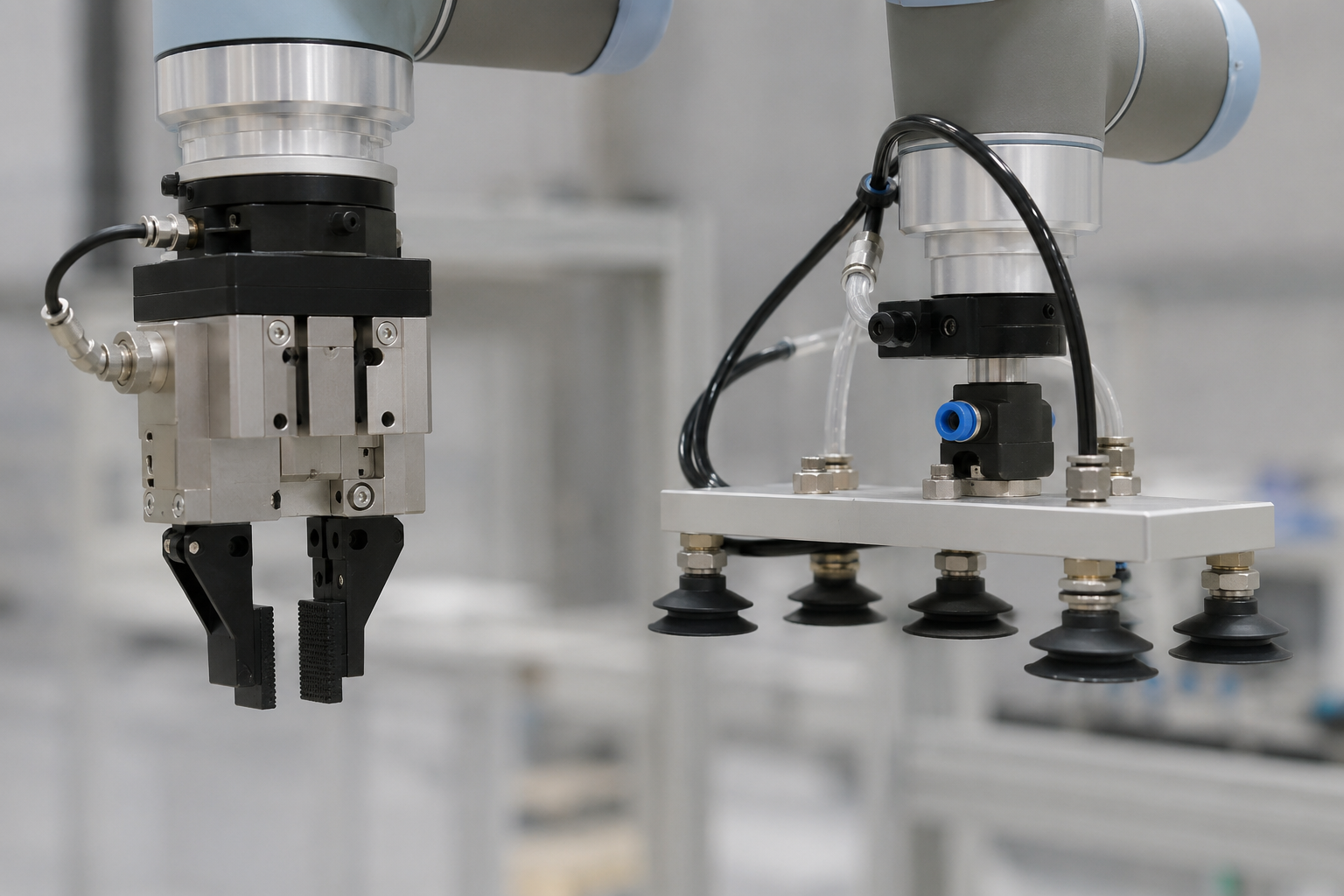
Robot grippers fall into five main designs with distinctly different price levels. Pneumatic grippers are the least expensive and start at 200 euros. Electric parallel and servo grippers are priced higher, at 1,000 to 6,000 euros. Vacuum, magnetic and adaptive grippers fall somewhere in between, depending on their design.
Pneumatic grippers use compressed air and are suited to recurring tasks involving uniform parts. They are fast, durable and proven, but offer less precise gripping force control. Typical models such as the SCHUNK MPG-plus or Festo DHPS cost around 200 to 2,000 euros.
Electric parallel or servo grippers offer adjustable gripping force, variable stroke and feedback to the controller. OnRobot highlights the all-electric operation of its electric parallel grippers, such as the RG2 or RG6. They are also suitable for harsh production environments. Some models are designed with an IP67 rating for wet and dusty areas. The price is roughly 1,000 to 6,000 euros.
Vacuum grippers pick up flat, smooth or large-surface parts, such as cartons, sheet metal or packaging. Individual vacuum cups and manifolds cost around 200 to 1,500 euros. Vacuum generation using pumps, valves and sensors costs another 500 to 3,000 euros. Electric vacuum grippers such as the OnRobot VGP20 generate the vacuum electrically on the gripper itself. They start at around 4,125 euros.
Magnetic grippers handle ferromagnetic workpieces such as metal blanks or sheets. They have a simple design and low wear, but require a thorough assessment of residual magnetism, metal chips and safety. Basic systems cost around 300 to 2,000 euros.
Adaptive or soft grippers handle delicate, irregular or highly variable parts. They are advantageous for high product variety, but are more expensive and in some cases slower than conventional grippers. A realistic price range is around 600 to 6,000 euros.
| Gripper type | Hardware purchase price | Operating costs | Typical use | Example models |
|---|---|---|---|---|
| Pneumatic gripper | 200 to 2,000 euros | medium (compressed air, wear) | uniform parts, fast pick-and-place tasks | SCHUNK MPG-plus, Festo DHPS |
| Electric parallel/servo gripper | 1,000 to 6,000 euros | low (no compressed air) | variable parts, adjustable gripping force | OnRobot RG2/RG6, SCHUNK EGP |
| Vacuum gripper (pneumatic) | 200 to 1,500 euros for vacuum cups, 500 to 3,000 euros for vacuum generators | medium to high (compressed air, filters) | flat, smooth parts, cartons, sheet metal | Festo EHMD-40-RE-GP, SMC ZXPE5 |
| Electric vacuum gripper | from around 4,125 euros | very low (no compressed air) | packaging, logistics, continuous operation | OnRobot VGP20 |
| Magnetic gripper | 300 to 2,000 euros | low | ferromagnetic blanks, sheet metal | SCHUNK MAGSA |
| Adaptive gripper (soft gripper) | 600 to 6,000 euros | low to medium | delicate, irregular parts | OnRobot Soft Gripper |
Payload, gripping force, stroke, precision, environmental requirements and part variety are the main factors that drive up gripper prices. These six factors raise the price considerably. Prices range from around 200 euros for basic models to over 10,000 euros for high-specification grippers. The greater the mechanical and sensor requirements, the sturdier and more complex the gripper needs to be.
Payload is the first factor. The heavier or more awkwardly shaped a workpiece is, the sturdier the gripper, fingers, drive and mounting need to be. Long gripping fingers or a large stroke increase the requirements. This calls for more torque, rigidity and accuracy.
Precision and repeatability are the second factor. A sturdy standard solution is sufficient for simple pick-and-place tasks. For assembly, electronics manufacturing or delicate components, force control, position feedback or a force-torque sensor are also needed. This increases the price of the gripper significantly.
The environment is the third factor. Dust, oil, coolant, heat or moisture require a higher protection rating, special seals or more durable materials. Requirements increase for food, pharmaceutical and cleanroom applications, and for applications requiring protection against electrostatic discharge (ESD). This drives the price up further.
Part variety is the fourth factor. If a robot has to grip different workpieces, rigid standard jaws are rarely sufficient. Adjustable grippers, adaptive gripping technology, tool changers or custom fingers then become worth considering. They all come at an additional cost.
Robot grippers rarely account for the largest cost block in an automation cell. The robot arm itself often accounts for only around one third of the cost. That is roughly 30 to 40 percent. The rest is spread across the end effector, peripherals, engineering and commissioning. The gripper price alone therefore only reflects part of the project cost.
The gripper hardware comes with further cost items: adapter plates, fingers, vacuum cups, sensors, valves, compressed air preparation, vacuum technology, cables, connectors and, if required, a tool changer. More complex systems also require force-torque sensors, camera systems or safety components.
Engineering work is the second hidden cost. This includes mechanical design, electrical and pneumatic planning, and robot programming. It also includes connection to the programmable logic controller (PLC), gripping trials, cycle optimization and documentation. This effort remains low for simple pick-and-place applications. For precision assembly or safety-critical processes, it can equal or exceed the cost of the hardware alone.
Operating costs complete the picture. Vacuum cups, seals, filters, lubricants and spare parts incur ongoing costs. Changeover times, maintenance and possible downtime must also be considered. This is why total cost of ownership (TCO), meaning the total costs over the life cycle, matters. It says more than the purchase price alone. Our article on market prices for cobots shows how this calculation looks for an entire cell.
Robot grippers with electric drives cost more to buy, but save money over their life cycle. An electric vacuum gripper operates entirely on electricity. It reduces maintenance and operating costs by up to 90 percent compared with pneumatic systems. This eliminates wear-prone hoses, valves and compressed air preparation.
Pneumatic grippers are inexpensive to buy, but rely on a compressed air supply. Compressed air is one of the most expensive energy sources in a production facility. There are also leaks, filter changes and the replacement of seals and hoses. These costs quickly add up in continuous multi-shift operation.
Electric grippers run on 24 volts DC instead of compressed air and offer freely adjustable gripping force. This lowers operating costs and protects delicate parts from damage. The higher purchase price pays off especially at high volumes and in continuous operation.
| Criterion | Pneumatic gripper | Electric gripper |
|---|---|---|
| Energy source | Compressed air (7 to 8 bar) | 24 volts DC |
| Compressed air costs per year | apply | none |
| Wear parts | Seals, hoses, filters | minimal |
| Maintenance requirements | regular | low |
| Gripping force control | limited | freely adjustable |
| Operating costs over the life cycle | higher | up to 90 percent lower |
The rule of thumb: with few shifts and simple parts, the pneumatic gripper remains economical. As soon as continuous operation, energy costs or delicate workpieces come into play, the electric gripper pays off, even though it costs more to buy.
Robot gripper budgets can be broken down by application complexity. Basic handling starts at around 1,500 euros in total costs, while general pick-and-place starts at 5,000 euros. Precision assembly starts at 12,000 euros, and applications with many part variants at 15,000 euros, including integration.
For simple handling of cartons, panels or containers, vacuum grippers or basic pneumatic grippers are usually sufficient. Hardware costs roughly 400 to 5,000 euros. With straightforward integration, total costs are around 1,500 to 10,000 euros.
For general pick-and-place applications with mixed parts and moderate precision, an electric parallel gripper with adapted fingers is a sensible choice. The hardware costs around 1,500 to 6,000 euros. Total costs of 5,000 to 15,000 euros, including integration, are realistic.
High-precision or delicate parts in electronics, medical devices or precision engineering require servo grippers, force control and sensors, or have ESD and cleanroom requirements. Hardware costs of 3,000 to 10,000 euros and total costs of 12,000 to 30,000 euros are typical here.
For many part variants and frequent changeovers, adaptive grippers, soft grippers or automatic tool changers are worthwhile. The hardware becomes more expensive, but setup times and misgrips decrease. Total costs of 15,000 to 40,000 euros or more are possible here.
| Application | Typical gripper | Hardware | Total costs incl. integration |
|---|---|---|---|
| Basic handling (cartons, panels) | Vacuum or basic pneumatic gripper | 400 to 5,000 euros | 1,500 to 10,000 euros |
| General pick-and-place | Electric parallel gripper plus fingers | 1,500 to 6,000 euros | 5,000 to 15,000 euros |
| Precision and delicate-part assembly | Servo gripper plus sensors plus ESD | 3,000 to 10,000 euros | 12,000 to 30,000 euros |
| Many part variants | Adaptive gripper, soft gripper, tool changer | 5,000 to 12,000 euros | 15,000 to 40,000 euros |
In specialized industries such as food production, pharmaceuticals, cleanrooms or foundries, costs can be significantly higher. This is due to hygiene, temperature or safety requirements.
Robot grippers are most economical when you combine a standard body with adapted contact surfaces. A set of 3D-printed gripping jaws often costs only 90 to 140 euros. A fully custom-built gripper, however, costs several thousand euros. The gripper body comes from the catalog. Only the fingers, jaws or vacuum cup plates are designed for the workpiece. A fully custom build only pays off for unusual shapes, tight tolerances or special materials.
A standard solution makes sense when the part geometry is simple and consistent. Catalog accessories then meet the requirements and implementation is fast. Standard components offer advantages in terms of spare parts, documentation and support.
A custom solution is worthwhile when workpieces vary greatly, are delicate, have unusual shapes or require special materials. A custom design may also be necessary for very tight tolerances, special hygiene requirements or an unusual reach.
3D-printed gripping jaws or fingers are an inexpensive way to start creating custom contact surfaces. Depending on size and material, a set often costs only around 90 to 140 euros. The design can be refined through quick iterations and adapted to the workpiece. This allows standard grippers to be tailored cost-effectively to a specific application before investing in milled metal jaws. Custom metal fingers and jaws, however, cost from several hundred to several thousand euros per set. Manufacturers such as SCHUNK demonstrate how broad the range is today, with pneumatic, electric, magnetic and adhesive grippers. This makes a precise technical specification all the more important.
There are four ways to source robot grippers. First, through an online marketplace with direct price comparison. Second, through a system integrator as part of a complete solution. Third, as a rented component of a temporary cell, and fourth, as an in-house design. The route you choose determines price, speed and the depth of integration.
Buying through a marketplace is the fastest way to achieve price transparency. On the Unchained Robotics marketplace, you can compare grippers, vacuum grippers and end effectors from different manufacturers by payload, gripping force and stroke. You can order directly. The gripper category currently lists over 120 models, ranging from finger and vacuum grippers to magnetic and soft grippers. The least expensive models start at around 210 euros. This is a good option when the technical specification is fixed and a standard gripper can do the job.
Working with a system integrator is worthwhile if you want a complete solution from a single source. One supplier then provides the gripper, robot, controller and safety equipment as a coordinated system. The additional cost of engineering and commissioning pays off for complex or safety-critical applications.
Rental is an option for peak project periods, testing phases or seasonal orders. If you need a complete cell, including the gripper, on a temporary basis, you can find the terms in the article on renting a robot instead of buying one. An in-house build only pays off with extensive in-house expertise and requirements that differ significantly from the norm. Design, procurement and testing often eat up the savings on the hardware price.
Budgeting correctly for a robot gripper starts with a clear specification and a contingency of 10 to 20 percent. Before making a selection, you should know the payload, center of gravity, workpiece geometry, surface, stroke, finger length, cycle time, tolerances and environmental conditions. Only then should you preselect the gripping technology and compare costs.
Next, draw up a shortlist of gripping technologies: pneumatic, electric, vacuum, magnetic, adaptive or a combination. For each option, it is worth comparing purchase costs, integration effort, maintenance, flexibility and the risk of failure. A complete budget covers the following items:
| Cost item | Typical components |
|---|---|
| Gripper body | pneumatic, electric, magnetic, vacuum or soft gripper |
| Gripping elements | Fingers, jaws, vacuum cups, magnets, contact surfaces |
| Sensors | Part presence detection, force-torque sensor, encoder, vacuum switch |
| Peripherals | Valves, filters, regulators, pumps, hoses, cables |
| Mechanical components | Adapter plates, mounts, tool changers |
| Engineering | Design, programming, integration, testing |
| Commissioning | Cycle optimization, validation, training |
| Operating costs | Wear parts, spare parts, maintenance, changeovers |
A contingency is advisable for new applications or those that are difficult to assess. It should be around 10 to 20 percent of the budget. Additional costs arise particularly in first-time projects due to adjustments, gripping trials or changed part requirements. Ultimately, the best robot gripper performs the task reliably. It causes little downtime over its life cycle and is rarely the most expensive item.
A robot gripper usually costs 200 to 6,000 euros for standard hardware. Basic pneumatic grippers start at around 200 euros, while electric servo grippers with sensors cost 6,000 euros or more. Complete vacuum systems or custom end effectors cost more. Many projects range from 1,500 to 30,000 euros when integration and commissioning are included.
Pneumatic grippers are the least expensive type and start at around 200 euros. They are suitable for uniform parts and fast pick-and-place tasks, but require a compressed air supply. If you include operating costs and maintenance, an electric gripper often works out cheaper in continuous operation. The purchase price, however, is higher.
The robot arm itself often accounts for only around one third of the purchase cost of a cell. The gripper is usually a smaller expense than the arm, but it is an integral part of the automation solution. Together with peripherals, engineering and commissioning, the sum of these additional costs usually far exceeds the price of the gripper alone.
A pneumatic gripper pays off when you run only a few shifts, handle simple parts and already have a compressed air supply. An electric gripper pays off in continuous operation, with delicate workpieces and when energy costs are high. Electric vacuum grippers reduce operating and maintenance costs by up to 90 percent compared with pneumatic systems. This eliminates the need for compressed air, hoses and filters.
Custom metal gripping jaws and fingers cost more depending on the material and complexity. A set ranges from several hundred to several thousand euros. 3D-printed gripping jaws, at around 90 to 140 euros, are an inexpensive starting point. They can be adapted quickly to the workpiece. In most cases, combining a standard body with custom contact surfaces is more economical than a fully custom-built gripper.
In addition to the gripper body, there are costs for adapter plates, sensors, valves, compressed air or vacuum technology, cables and tool changers. Engineering, programming, gripping trials and commissioning are added, along with ongoing expenses for wear parts, maintenance and changeovers. This total cost of ownership is more informative than the purchase price alone.
Robot grippers are available through online marketplaces with direct manufacturer comparisons, through system integrators as part of a complete solution, or as rental components. On the Unchained Robotics marketplace, you can filter grippers, vacuum grippers and end effectors by payload, gripping force and stroke. You can order directly.
A contingency is advisable for new applications or those that are difficult to assess. It should be around 10 to 20 percent of the gripper budget. Additional costs arise particularly in first-time projects due to gripping jaw adjustments, additional gripping trials or changed part requirements. These are difficult to quantify in advance.